

Rethinking Team Formation: Lessons from An Engineering Job Fair
Introduction
As Scilife’s Agile Delivery Lead and a member of our engineering leadership team, I’ve been working closely with our 20-person engineering org to evolve how we work as we scale. Our team is geographically distributed across Central and Eastern Europe and India. These regional boundaries have historically been reinforced by differences in tech stack and domain ownership. The India team, for instance, has held primary responsibility for maintaining and bootstrapping the product, while the European team has focused on infrastructure, DevOps, and new feature development.
As we prepare to scale both the organization and the product, we’re facing a familiar challenge: how do we grow sustainably, distribute ownership fairly, and keep team members engaged?
Why Traditional Top-Down Reorgs Weren’t Enough
I’ve seen the limits of top-down reorgs in past roles and consulting work, and similar constraints were surfacing at Scilife. Our engineering managers (EMs) are still getting acclimated to the way work flows through the system. The India team, while productive, has been largely shielded by their manager—creating silos that hinder cross-regional collaboration.
In this context, imposing a new team structure from above would only perpetuate separation. We needed a bottom-up approach to shake up old patterns and reinforce a more collaborative culture.
Enter: The Job Fair — A Participatory Approach to Team Formation
The job fair is a technique I’ve used in multiple tech orgs, including during my time as a consultant. At Scilife, we saw the right conditions to apply it thoughtfully and in-house. Sometimes it becomes a yearly tradition. Sometimes it’s a one-time intervention. Either way, it’s always revealing.
At its core, the job fair puts the decision of team membership into the hands of the team itself. People choose what they want to work on—and who they want to work with.
Our Goals
We anchored the job fair at Scilife in three goals:
- Streamline ownership: We wanted a more equitable distribution of responsibility and a clear shift from individual to team-based ownership.
- Increase autonomy and clarity: Autonomy thrives on clarity. By giving teams well-defined domains, we expected them to make more decisions on their own.
- Improve engagement and fit: By allowing individuals to choose their team, we leaned into intrinsic motivation and personal agency.
How the Job Fair Worked
The mechanics were simple and transparent:
- Predefined team structures: The leadership team aligned on four cross-functional teams (plus a fifth Infra/DevOps team that remained unchanged). Each team had defined scopes and skill requirements.
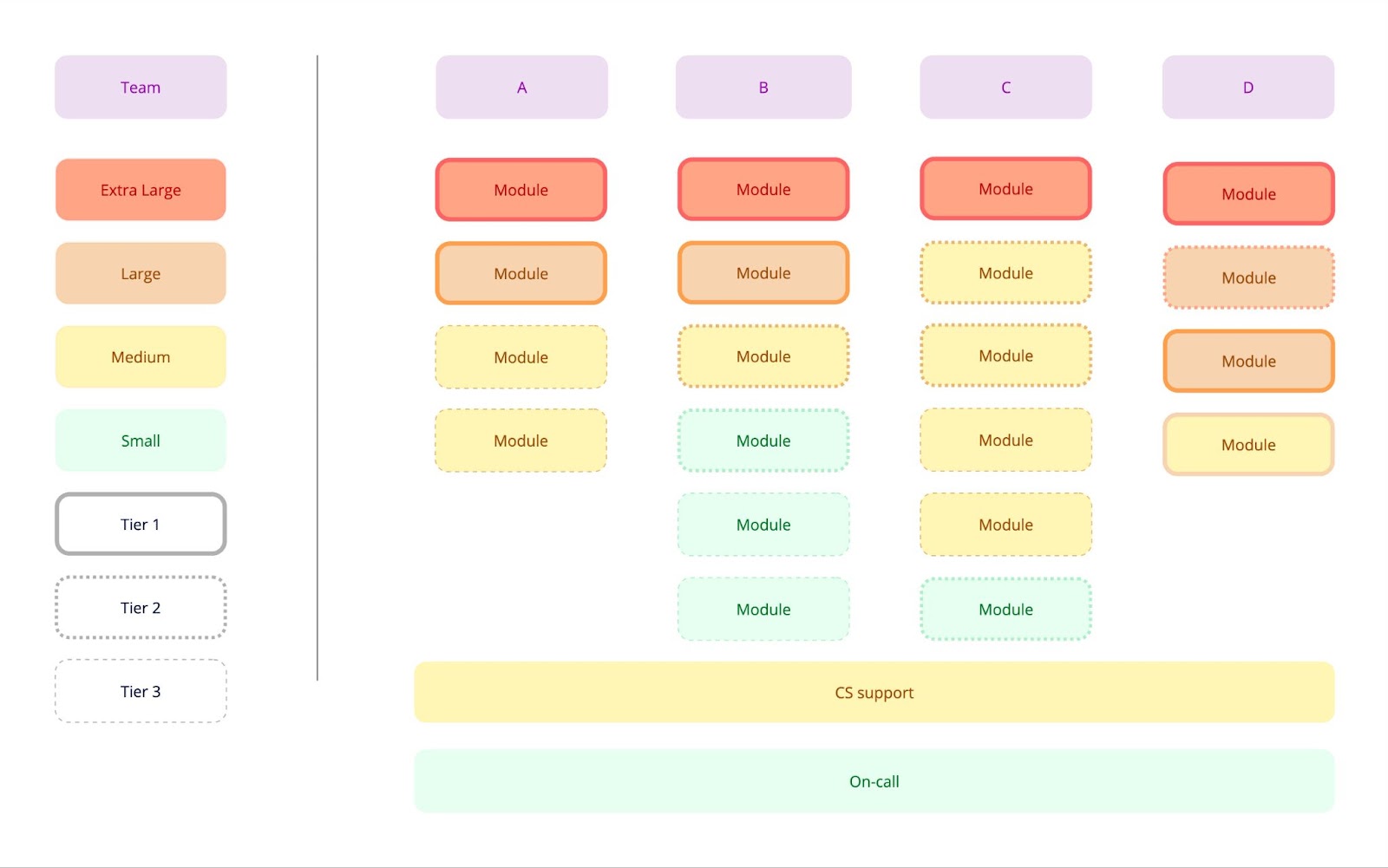
- EMs pre-assigned; Product roles float: Each of our two EMs would lead two teams. Product Managers and Designers would float across teams to maintain shared product context.
- Miro-based voting: Team members placed green (1st choice) and blue (2nd choice) stickies on Miro boards corresponding to their desired teams. They could view and adjust their votes during the five-day window.
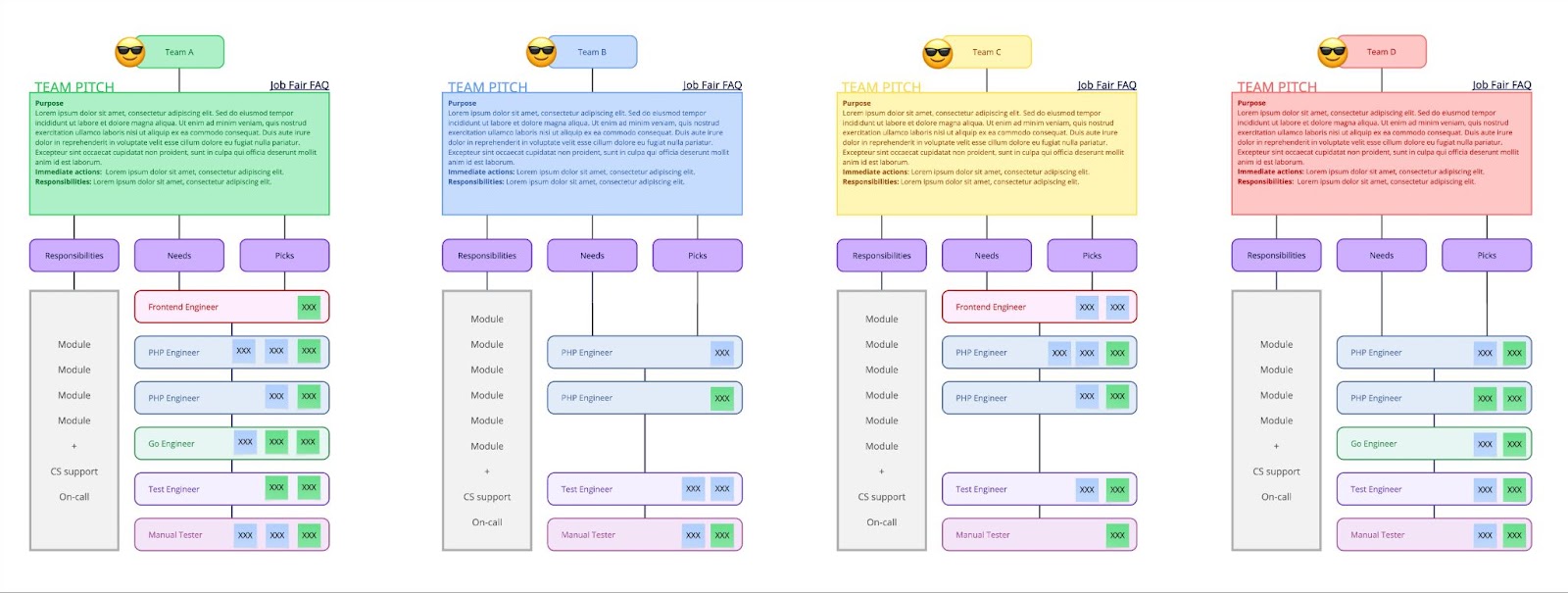
- Clear rules, open process: Voting rules were posted transparently. People could only move their own stickies, had to vote for two different teams, and could vote even if a role slot was already “occupied.”

- Collaborative adjustments: After voting closed, we held a calibration session with the VP Engineering and EMs to review outcomes and resolve edge cases. 1:1s were scheduled where necessary to ensure people felt seen and heard.
Designing the Experience
To ensure buy-in, we started with a written proposal to executive leadership. Concerns were raised—about morale if someone didn’t get their top choice, or about knowledge silos forming. We addressed these concerns openly, and the VP Engineering and I co-piloted the rollout.
We launched the initiative at our quarterly tech all-hands. A FAQ (co-drafted with ChatGPT) anticipated common questions. The kickoff included:
- A pitch from our VP Product on each team’s domain and focus
- A walkthrough from our VP Engineering on team composition and EM assignments
- A live voting demo, led by me
Throughout the voting week, we used a dedicated Slack channel to share reminders and encouraged EMs to have informal chats with potential team members.
Meanwhile, we worked behind the scenes on the heavy lifting—Slack channels, Confluence spaces, Jira migrations, and changes in reporting lines. And we began planning thoughtful team kickoff workshops to make sure each team started strong.
The Role of Product and Leadership
“Organizations which design systems … are constrained to produce designs which are copies of the communication structures of these organizations.”
We were intentional about how modules were assigned. Tier 1 modules—those critical to long-term business success—were distributed evenly. So were levels of technical complexity. Our Product and Engineering leaders collaborated closely to ensure that each team had a sustainable and meaningful scope.
Crucially, leadership guided without controlling. We may have had ideas about “ideal” teams—but we prioritized the wisdom of the team over our own assumptions. In coaching individuals who felt anxious about choosing, I encouraged them to define their own decision-making criteria—whether it was growth, mentorship, technical challenge, or simply a desire to try something new.
Cultural Shift: From Top Down to Empowerment
The job fair is a tool—but the mindset shift is the real outcome. We’re replacing top-down task assignment with real agency. Engineers are no longer waiting for instructions. They’re actively shaping their teams and responsibilities. We’re asking them to lean into ambiguity, to self-organize with structure—not chaos.
By honoring choice, we’re building a culture of accountability and shared ownership.
Success Metrics and Feedback Plans
To evaluate the success of the job fair, we’re tracking:
- Placement satisfaction: 85% received their 1st choice, 10% their 2nd, and 5% were assigned.
- Morale and engagement: Tracked via 1:1s and observed participation in team ceremonies.
- Team delivery metrics: We’ll monitor cycle time and throughput and aim for stable forecasting next quarter.
- Feedback loops: We’re running retrospectives with leadership and gathering survey feedback from participants.
Lessons (And Tradeoffs)
Not everything went perfectly. One team raised concerns about a lack of seniority. Another lacked critical mass of interest. The EMs are still building relationships and context—particularly with team members in India. We’re navigating all of this with transparency and empathy.
In the end, viability trumps idealism. Some people didn’t get their first choice, and some teams may still need reshaping. But by communicating early and often, we’ve preserved psychological safety—and built a shared commitment to learning our way forward.
What’s Next
We’re now entering the transition phase. Up next:
- Team kickoff workshops
- Manager transitions and handovers
- Internal communications to Sales, CS, and other functions
Check out our blog post about how to run effective team inceptions, and stay tuned for a practical playbook geared to new Engineering Manager.
Final Thoughts
I’m proud we brought the job fair to Scilife. It’s not just a process—it’s a signal of how we’re evolving our culture from within. A signal that we trust our people. That we value agency. That we believe in designing for adaptability.
This isn’t a staffing exercise. It’s a step toward a more human-centered engineering culture. It’s the kind of mindset I’ve always tried to cultivate—one rooted in agency, adaptability, and care for people. And it’s exciting to put it into action as part of the Scilife team.
If you’re curious to try this at your company—or if you’ve already tried something similar—I’d love to hear your reflections. Let’s keep building the future of work, together.
A bit about my role at Scilife
I’m the Agile Delivery Lead and part of our engineering leadership team. My work focuses on helping tech orgs build systems that foster autonomy, clarity, and shared ownership. Before joining Scilife, I supported teams through internal roles and consulting work—and I carry those lessons forward as we keep shaping the way we work, together.