
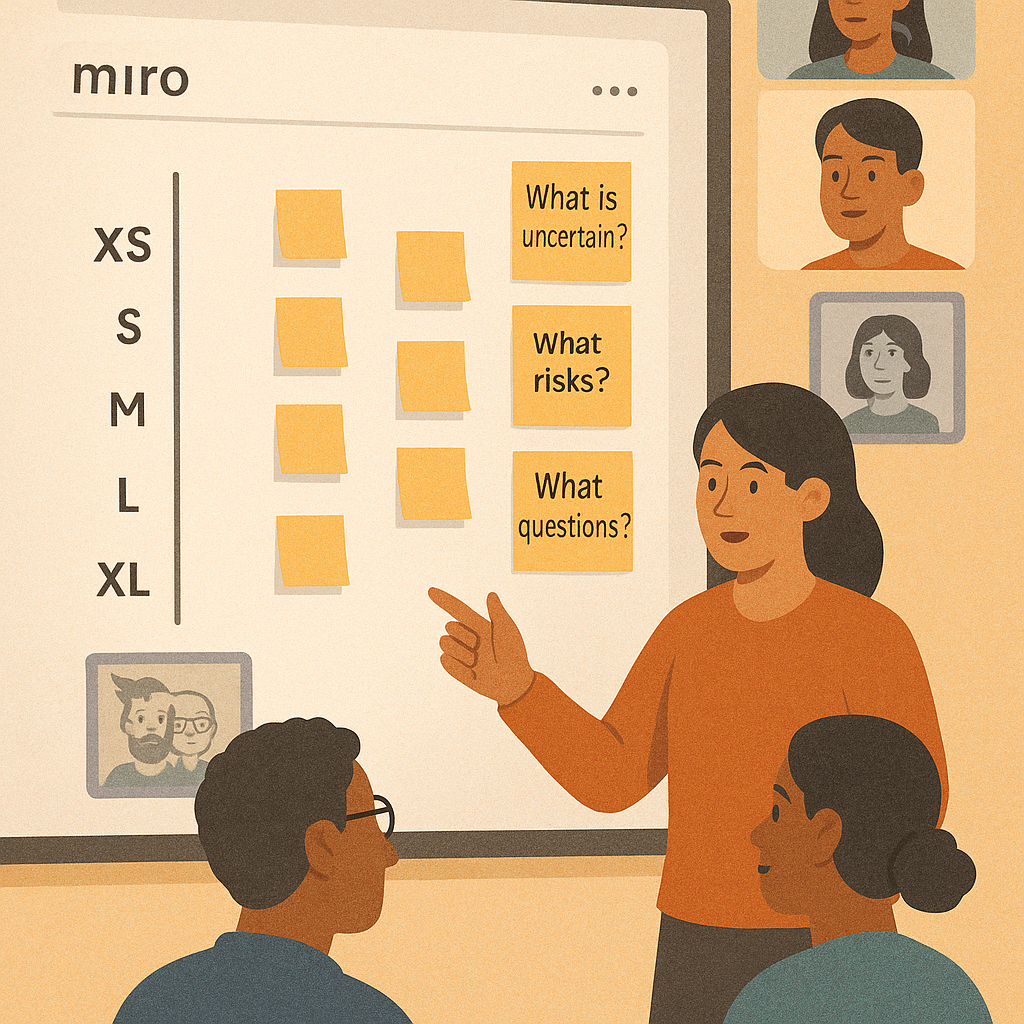
Why Estimation is Your Secret Weapon for Better Quarterly Planning
Part 1 of the Estimation, Measurement & Forecasting Series
When your product team starts thinking about the next quarter, you’re not trying to predict delivery dates. You’re trying to understand the shape of the work ahead.
Estimation helps you do that. Not because it gives you certainty, but because it reveals what you don’t know yet. Done right, estimation becomes a shared exploration that feeds both strategic planning and future forecasting.
Estimation is about insight, not precision
When someone asks “How long will it take?” the better question is, “What do we understand about this?”
Estimation is a learning practice. It’s a way to surface assumptions, dependencies, and uncertainties before they become surprises. It turns abstract ideas into something tangible and comparable.
The outcome isn’t a number, it’s a better conversation. That conversation lays the groundwork for measurement later. Once you’ve estimated, you can start collecting real data on how work actually flows and compare learning with evidence.
How to do this in practice: estimating your quarterly roadmap
Quarterly planning usually begins with a ilst of proposed initiatives. Before you can prioritize or forecast, you need to understand relative size and complexity.
Here is a simple, collaborative way to do that. The objective is to build alignment and clarity without falling into the “guess the date” trap.
Step 1: Kick off with magic estimation
Invite the entire team.
The Product Manager presents each feature, covering the following:
- Who it’s for
- What problem it solves
- What’s in and out of scope
- Dependencies and known risks
The goal isn’t to decide how long something will take, but to help everyone see what’s involved.
Step 2: Silent sorting
Before you start, warm the team up with Mike Cohn’s “Zoo Estimation.” It’s quick and fun: ask everyone to size animals (ant, rabbit, dog, tiger, hippo) relative to each other. People laugh and then realise how naturally they can align when comparing relatively instead of absolutely. That mindset is exactly what makes estimation work.
Now, move to your actual features. On a Miro board, draw a vertical line labeled XS —> XXL.
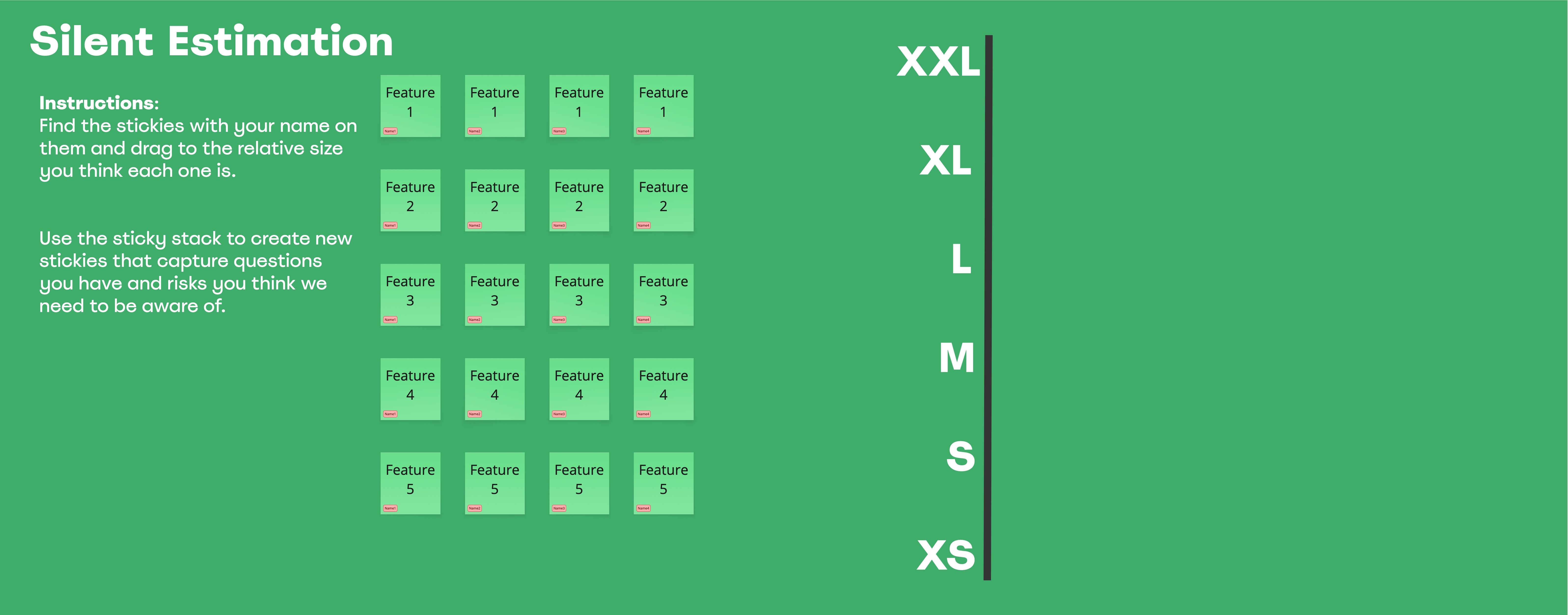
In silence, team members place each feature on the line, comparing only relative size: bigger, smaller, or similar.
Use Miro’s “private mode” so that each person’s placements stay invisible until everyone is done. That way, no one’s choices influence anyone else’s. You get each person’s true, unfiltered perspective.
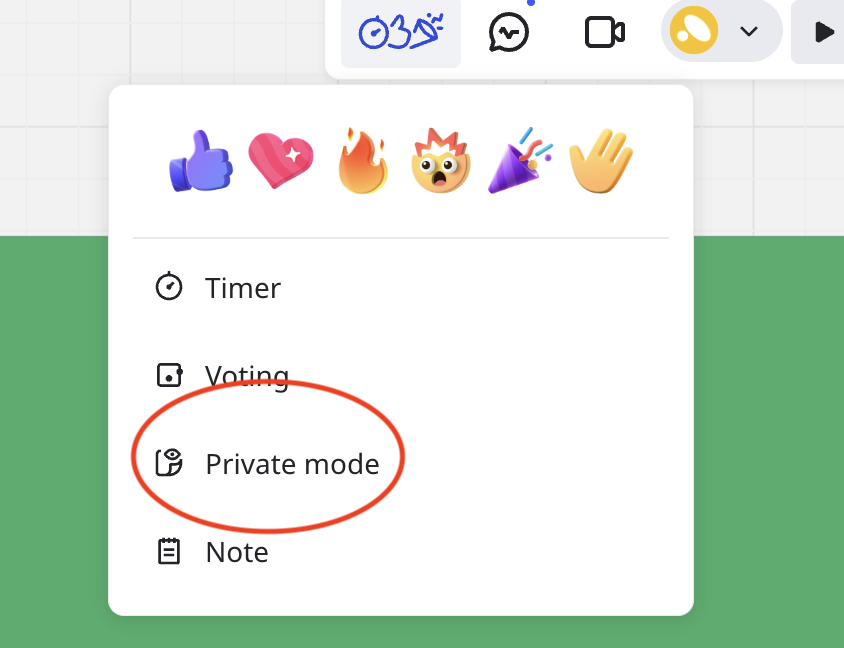
No debate yet, just intuition and pattern recognition.
Step 3: Facilitate the dialogue
Now bring conversation back in.
Ask:
- What made you place this here?
- What feels uncertain or risky?
- What do we still need to clarify?
- On a scale from 1-5, how complex does this feel?
Capture everything on the Miro board. The richness lies in the reasoning behind people’s decisions.
“The squared error of the collective prediction equals the average squared error minus the predictive diversity.” — Scott Page, The Difference
This is the science behind the wisdom of the crowd.
Step 4: Close the learning loop
Take unanswered questions back to stakeholders or experts. Return with answers and re-run the estimation. Each round sharpens the shared understanding and reduces uncertainty.
The result?
Your team doesn’t just have a list of features; they have a map of complexity, risk and unknowns. That’s what good planning looks like.
Why this matters for quarterly planning
When estimation becomes part of your rhythm, quarterly planning stops being about promises and starts being about understanding.
It’s about:
- Creating shared understanding of the work ahead
- Surfacing assumptions and risks before they turn into surprises
- Indexing towards relative sizing instead of chasing false precision
- Gathering each person’s independent perspective before converging as a group. Tapping into the full wisdom of the team.
Estimation doesn’t eliminate uncertainty, it makes it visible. Once you can see what’s uncertain, the next question is: how do we reduce it before we start building?
That’s where discovery comes in. It’s how you turn “we think” into “we know,” refine estimates into clarity, and set your team up for better decisions down the line.
As teams mature in how they plan, many evolve from quarterly commitments to a Now-Next-Later approach. It keeps focus on flow and learning instead of fixed timelines. Dates are reserved for external or internal business commitments. Everything else lives in flexible queues that continuously adapt as the team learns and landscape changes. It’s rolling planning, not rigid prediction, and estimation is what makes that possible.
Before you go:
What is the real success of your next planning cycle wasn’t how accurate your estimates were but how much uncertainty you uncovered early?
Try this:
At your next roadmap estimation session, pause before discussing delivery dates. Ask your team, “What feels the most uncertain here?” and capture every answer. That list, not the t-shirt sizes or story points, might be your most valuable output.
Up next: Part 2: From Idea to Delivery: How Discovery Supercharges Estimation Accuracy.
We’ll explore how structured discovery helps teams de-risk work early, sharpen estimation accuracy, and move from broad assumptions to confident alignment before delivery even begins.